
Fifteen years ago, on July 9, 2011, the flag of the Republic of South Sudan was raised in the capital city of Juba. South Sudan, however, was not born on that day. For more than a century before independence, Sudan’s southern regions had been governed and conceptualized as separate entities, both materially and theoretically.
Throughout the Turko-Egyptian and later Anglo-Egyptian condominium, colonial administrators erected a legal architecture of separation.
One of the most significant was the “Southern Policy” of 1930. The policy legally detached the southern regions from the rest of the Sudans by fragmenting communities into administratively convenient “tribal units,” requiring passports to travel through the Sudans and imposing English through missionary schools that banned Arabic in the southern regions.
Additionally, the Gezira Scheme, launched with the Sennar Dam in 1925, redirected two million acres of fertile land not to feed Sudanese people but to produce long-staple cotton for the textile mills of Lancashire in Britain.
The southern regions were underdeveloped to feed London.
Thus, the 2011 flag independence did not produce a new nation so much as it formalized a century-old imperial design. The “birth” was a christening and rebranding of fragmentation as self-determination. Joseph Garang, a core member of the Sudanese Communist Party, warned of the dangers of separation decades before the flag of South Sudan was raised. He identified three political tendencies among Southern intellectuals: the extreme right-wing, perplexed intellectuals, and the left.
The Extreme Right-Wing demanded separation on racial logic, making claims such as “Since one cannot change negro into Arab nor Arab into negro, the two must separate.” Garang rejected this, arguing that “racial prejudice is a manifestation of a more hidden factor,” namely, economic exploitation through the processes of colonialism.
Next were the Perplexed, who hated Khartoum but feared becoming “another Congo.”
This refers to the 1960-1965 crisis, when Belgium-backed secession, CIA intervention, and the assassination of Patrice Lumumba produced a repressive neocolonial state.
Some within this second school suggested the South should “separate and immediately turn communist” but did not articulate a path to doing so.
Garang aligned himself with the third school, the left, which viewed imperialism as the primary contradiction and insisted on an alliance with Northern democratic movements. The current conditions in the Sudans confirm that his warning, “if the South were to separate today, it would become an imperialist colony tomorrow,” rings true.
South Sudan gained independence without a Pan-African anti-imperialist military force.
A convergence of pressures pushed the Sudanese government to sign the Comprehensive Peace Agreement (CPA) in 2005. Those pressures included the War on Terror, the threat of U.S. sanctions, and Khartoum’s designation as a state sponsor of terrorism.
Theoretically, the CPA was meant to end the Second Sudanese Civil War. What it did, however, was solidify U.S power.
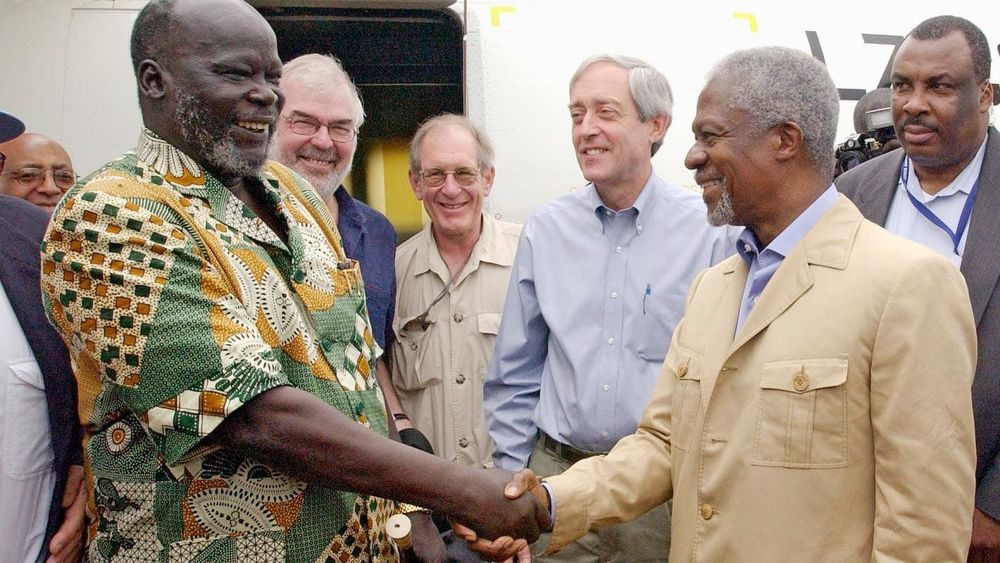
The United States was a key “mediator” in the talks. American officials were present at the signing in Nairobi on January 9, 2005, and served as guarantors of the deal that set the terms for the 2011 referendum.
South Sudan gained independence under the presidency of the first Black president of the U.S., Barack Obama. Hilary Clinton, who was Secretary of State under Obama, proudly declares the U.S. as the midwife of South Sudan.
Obama’s administration portrays the separation of the Sudans as a solution to decades of war. The contradiction, however, is the U.S. played a critical role in creating and expanding the wars. Even as far as issuing annual waivers to bypass the Child Soldiers Prevention Act, legislation that bans U.S. military “assistance” (read: weapons, surveillance, extraction) to governments that recruit or use child soldiers.
In the words of the brilliant Decolonial Afro-feminist, Sylvia Tamale, “All state violence against the people occurs within a legal framework, which is used to legitimize and legalize oppression.”
Separation delivered a legally armed client, not a sovereign state.
Salome Ayuak and Sudanese Resistance Front
The Sudanese Resistance Front is an anti-imperialist organization dedicated to defending Sudanese self-determination and sovereignty. This Substack is a space for sharpening our analysis of concrete conditions. We begin with a reflection on fifteen years of South Sudanese independence. We write as organizers in the diaspora, accountable to movements on the ground.