

Table of Contents
There's no such thing as a bloodless revolution.
- Malcolm X
To sacrifice sons in the war ought to be a cause not of pain but of pleasure to brave men.
- Mahatma Gandhi
Confronting power
History repeatedly teaches us that violence is an inevitable consequence of nonviolent action. No matter how many battered cheeks have been turned the other way, nonviolent movements remain painted in the blood splatter of vigilante kidnappings, vicious beatings, sexual assaults, terroristic bombings, pedagogical lynchings, political imprisonment, indiscriminate killings, and state-sanctioned assassinations. Research validates this observation. According to Harvard political scientist Erica Chenoweth, “Of the nonviolent revolutions between 1900 and 2019, regimes responded with lethal repression 88% of the time.”1
Nonviolence yields this repressive result because, at its best, nonviolence is a serious confrontation with power. Power, when governed by the capitalist ideologies of imperialist accumulation and colonial domination, is a supremely violent force. Therefore, it will inevitably react violently when threatened, for that is the nature of power. It need not matter the character of how one goes about threatening it.
If one confronts a bear over who controls the honey, the bear will kill to control it. The raging bear does not care if the struggle is armed or nonviolent. It's a simple equation: once the bear is poked, bloodshed is imminent. In the end, somebody's gotta die for the honey.
This extends beyond a just metaphor. For example, in Palestine, land is the honey, so Zionists kill Palestinians for it. They kill them when they peacefully confront them on their feet (Great March of Return) and even more when they forcefully confront them with arms (Al-Aqsa Flood). Neither a knife nor a hug makes a difference; they want the land.
Like decolonization, confrontation with power is “a violent phenomenon.”2 Nothing supersedes this basic fact, no matter how peacefully one confronts it. So what materially separates nonviolence from violence when the confrontation demands that someone will unavoidably die either way?
I propose that no material difference exists. Inflicting harm is no more violent than receiving it. Killing is no more violent than being killed. Digging a grave is no more violent than filling one. Ultimately, a body count accumulates, impervious to the method.
But violence never disappears. It merely attacks select targets depending on the conditions at hand. From there, the only remaining questions are Who dies? and For what strategic purpose?
To properly engage these questions, we must move beyond the age-old debate of violence vs nonviolence, for such a binary is immaterial.
To be clear, this does not mean certain moral and tactical considerations for peace are irrelevant. Yet, it does mean that none exist outside of violence, because nonviolence is violence, too.
One may ask, Well, what is violence? For definitional purposes, we will rely on Chenoweth's straightforward definition: “an action or practice that physically harms or threatens to physically harm another person.”3 Now, what is nonviolence? Again, we refer to Chenoweth's definition of civil resistance: “a form of collective action that seeks to affect the social, political, or economic status quo without using violence or the threat of violence against people to do so.”4 These will be our operating definitions.
Sacrificial violence—Nonviolence, weaponized
Kwame Toure's oft-quoted quip that "In order for non-violence to work, your opponent must have a conscience. The United States has none."
During a candid 1967 speech, Kwame Toure, civil rights organizer and revolutionary Pan Africanist, explained the philosophy of nonviolence put forth by minister Dr. Martin Luther King Jr.: “His main assumption was that if you are nonviolent, if you suffer, your opponent will see your suffering and will be moved to change his heart.” Later, he warned that Dr. King, “made only one fallacious assumption. In order for non-violence to work, your opponent must have a conscience. The United States has none.”
Along with naming the moral bankruptcy of the United States, Toure was questioning the limitations of philosophical nonviolence. On the one hand, when applied as a philosophy—utilizing one's suffering to redeem the heart of the opponent who causes it—a conscience is required for transformation to occur.
Yet, I would offer, when applying nonviolence as a tactic—utilizing the brutality of an opponent against them to extract concessions tied to strategic objectives—a conscience is not required. The primary goal is to exploit their heartlessness to gain support from people who may otherwise be indifferent or afraid. Upon receiving this support, one may galvanize it to momentarily force the opponent to change their behavior out of necessity, not conscience.
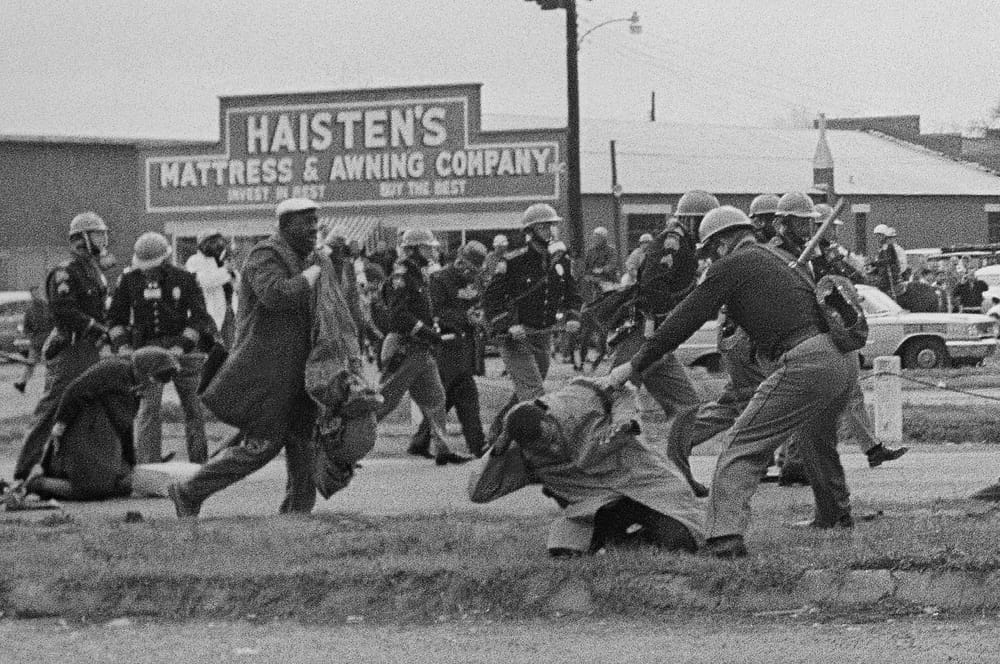
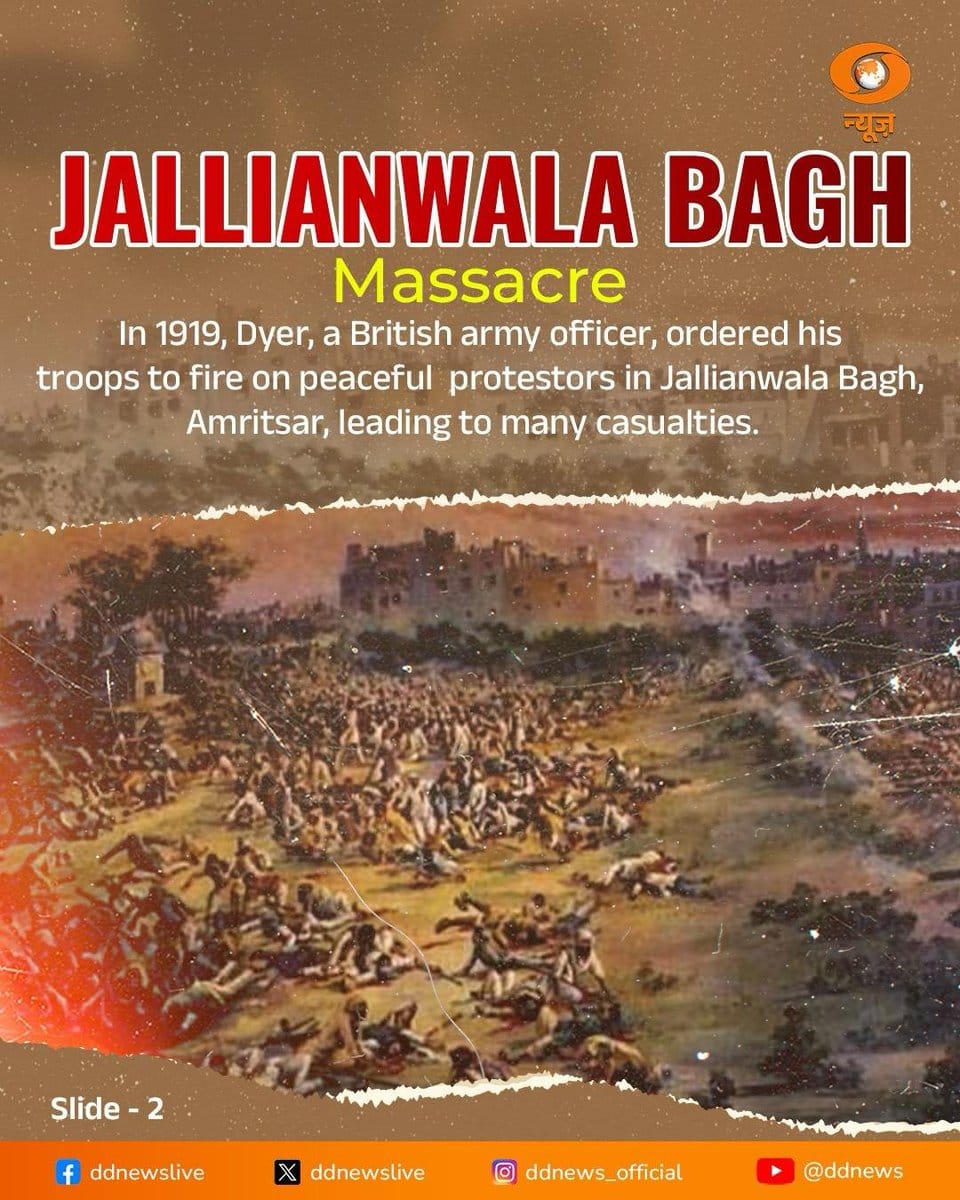
Nonetheless, philosophical or tactical, what is almost always required from the opponent for nonviolence to work—is violence. Hence, there is no Voting Rights Act without Bloody Sunday. There is no Indian independence without the Jallianwala Bagh Massacre. There is no Republic of Ghana without the British crackdown on the Convention People’s Party. Without the shock and awe of violence, so-called nonviolence would be unsuccessful. Conscience or not.
This begs the question that paupers the contradiction:
How do we make sense of nonviolence when violence itself is the common denominator? How can we call it nonviolence when violence is the activating ingredient, the yeast that helps bring peace to the top?
Political scientist Gene Sharp wrote about how nonviolent practitioners deploy a sort of “political jujitsu” against their opponents.5 By absorbing the opponent's brutality through the political martial art, the idea is that they are “throwing him off balance politically, causing his repression to rebound against his position, and weakening his power.” In short, nonviolent practitioners exploit the violence set upon them to tip the scales in their favor.
Thus, political jujitsu is an open acceptance of violence. The difference is that the nonviolent practitioner says, “If there must be violence, may I be the one to suffer it.” Gandian disciple and nonviolent tactician, James Lawson was clear about this, “We want the cycle of violence in America and racism stopped. So we will take it on ourselves, we will not dish it out in kind.”6
Still, a refusal to dish out violence does not exclude one from the cycle. Not when one solicits violence to then suffer it away. As Dr. King daringly wrote following the Montgomery Bus Boycott,
Bomb our homes and threaten our children; send your hooded perpetrators of violence into our communities and drag us out on some wayside road, beating us and leaving us half dead, and we will still love you. But we will soon wear you down by our capacity to suffer.7
Similar to Lawson, King implies that suffering at the hands of violence is a cleansing act that can end the cycle of violence. King saw suffering at the hands of death as a redemptive Christian ethic to free “his white brethren from a permanent death of the spirit…”8
This raises an interesting parallel between two seemingly opposing views. Anti-colonial philosopher Franz Fanon wrote the infamous line in The Wretched of the Earth, “At the level of individuals, violence is a cleansing force.”9 According to Fanon, when colonized people engage in revolutionary violence against the colonizer, they can restore dignity, self-respect, and ultimately, defeat the original violence imposed on them by colonialism. Thus, for both sides, violence is cleansing, just by different means. Regardless, violence is served.
In a capitalist society constructed by white colonial rule and imperial sovereignty, we all eat the violence. One stuffs the dish while the other dishes it back out. Dr. King's Christian faith accepts this as much. As Jesus said to the multitudes, “...the kingdom of heaven suffereth violence, and the violent take it by force.” Although the nonviolent practitioner may not physically throw the sweeping punch or fire the loaded pistol, they welcome a confrontation with a violent force that will surely unleash more upon them, and the flock they lead to battle. Thus, courting violence cannot materially be understood as nonviolent.
However, it can be described as heroically sacrificial. Dr. King saw the parallels. “The way of nonviolence means a willingness to suffer and sacrifice.” They nobly sacrifice themselves to deadly assaults in order to convert it all into a positive force.
Therefore, a more appropriate term for nonviolence is sacrificial violence. We can understand sacrificial violence as an act where one foments the violence of their opponent, and then willfully consumes it as a sacrifice for a specific set of objectives. In this sense, sacrificial violence is a form of unconventional warfare met to even asymmetrical odds. Recognizing their advantages do not rely on brute force; their weapons of choice become moral authority, mass disobedience, public sympathy, and their ability to suffer.
Indian freedom fighter Mahatma Gandhi was absolutely clear on the sacrifices of war: "We are entering upon a life and death struggle, a holy war; we are performing an all-embracing sacrifice in which we wish to offer ourselves as an oblation.”10 During the Salt March—a 24-day direct action where Indians defied British rule by refusing to use British salt or pay taxes—Gandhi was so adamant about sacrifice that he ordered his followers to take the strikes of the British without blocking the blows.11 Proving that the more exaggerated the opponent's violence becomes, the more those who make the sacrifice obtain the upper hand.
A “nonviolent” response to nonviolence
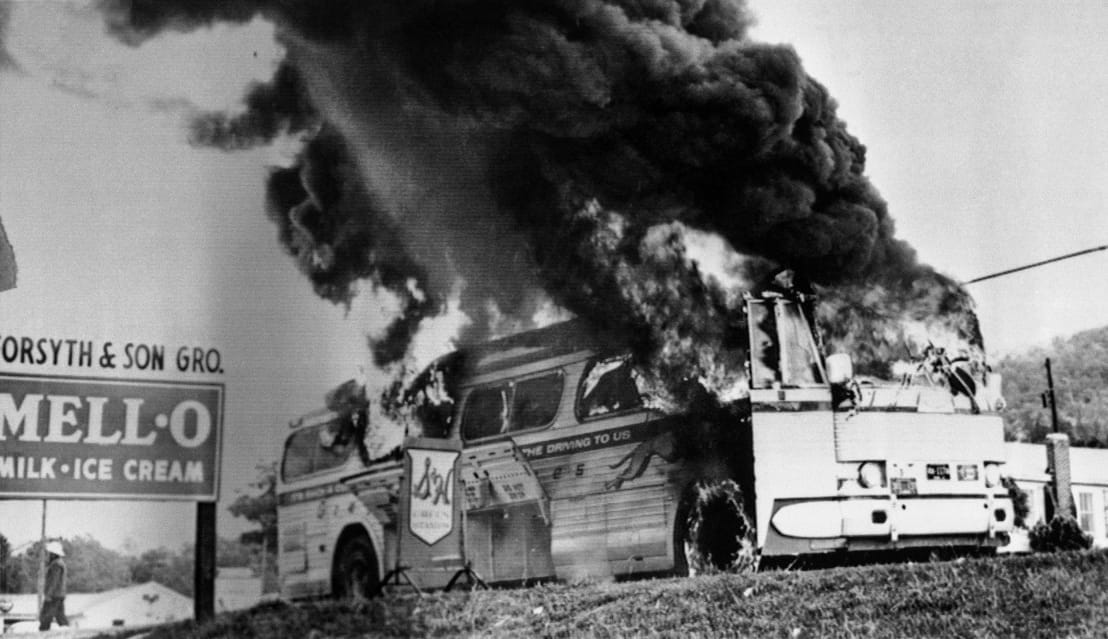
The weakness of sacrificial violence is that it only works when there is sufficient violence to immolate. It's a flame that requires constant flirtation with death, which burns out if not properly goaded. Thus, the target for sacrifice must have a strong proclivity for violence.
If not for the violence of US white southerners, the Civil Rights Movement would have likely struggled to dismantle Jim Crow. Dr. King said as much in 1967, “In the South, in the nonviolent movement, we were aided on the whole by the brutality of the opponent.” One of the most notorious campaigns was the Freedom Rides, where Black and white activists rode interstate buses throughout the South to challenge illegal segregation. White southerners reacted to the challenge with harsh beatings and attempted murder.
Throughout their voyage down south, Freedom Riders were often attacked by white southerners, but the most violent incident was the Anniston Bus Burning.12 On Mother's Day, 1961, in Anniston, Alabama, a white mob led by the Ku Klux Klan met a group of Freedom Riders outside their Greyhound bus. They shot the tires, they nearly flipped over the Greyhound, tossed a firebomb inside it, and held the door closed so the Freedom Riders could not escape. An undercover Alabama state cop flashed his badge and pointed his gun at the Klan to force the door open. Had nobody carried a gun on that imperiled Mother's Day, they would have certainly died.
Nonetheless, the sheer violence of the Freedom Rides, especially since the casualties included white Freedom Riders and a white federal aide to the president,13 made international news. The 35th president was embarrassed because now Civil Rights, an issue he had given little attention to up to that point, had essentially gone viral. Despite near-death experiences, this was a major victory for the Civil Rights Movement. Hundreds of new people joined the Freedom Rides, and it internationally exposed the brutality of the US South in the middle of the Cold War. Birmingham Reverend Fred Shuttleworth proclaimed, “This is the greatest thing that has ever happened to Alabama.”14 Yet, had the Freedom Riders been arrested without aggression, a victory would not have been won.
The Freedom Rides were a 180° difference from the Albany Movement, which began later that year in Albany, Georgia. The Albany Movement was an attempt by Black residents to desegregate the city of Albany, led by the newly formed Student Nonviolent Coordinating Committee. Instead of a police force that actively collaborated with the KKK, like in Anniston, Albany had a savvy, disciplined police chief named Laurie Pritchett.15
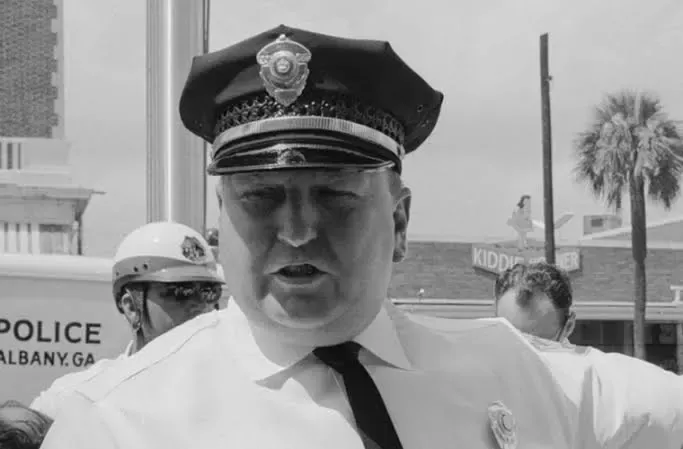
Chief Pritchett studied the tactics of sacrificial violence. Instead of physically assaulting protesters, he ordered his police to handle the protesters with caution while arresting them. He knew one of the goals was to flood the local jail with protesters, so he had them sent to jails throughout the state to avoid overwhelming Albany. Instead of charging them for breaking segregation laws, he charged them with disturbing the peace or unlawful assembly. This tactic prevented legal challenges. When Dr. King was arrested, a private donor paid his bond so he could not wallow away in jail for free publicity.
In the end, the Albany Movement failed to desegregate the city. The newspapers at the time reported that “he [Pritchett] defeated nonviolent direct action with nonviolence.”16 This is an exaggeration since police are violence workers by definition of the job, but Chief Pritchett was successful in neutralizing their tactics.
Chief Pritchett proved that sacrificial violence fails if one cannot provoke the opponent into their worst impulses. You cannot delegitimize an opponent who seems reasonable to the dominant public. Albany taught the movement to target the most racist, violent areas not only because it helped the people most in need, but it also yielded the greatest success.
There's nothing nonviolent about dramatizing evil
In defense of nonviolence, Dr. King once wrote in Ebony Magazine,
The nonviolent strategy has been to dramatize the evils of our society in such a way that pressure is brought to bear against those evils by the forces of good will in the community and change is produced…
Unfortunately, there's nothing nonviolent about dramatizing evil. That usually means somebody's gotta die. It also means that the pressure it creates will take on a violent form.
Thus, pressuring a State to uphold your civil rights requires violence to enforce them. If and when the State fails to enforce them, when it fails to protect its most vulnerable, someone will inevitably fill that void with violence. Organizing for revolution is no different. To defend the revolution, a people will need to exhaust all means against those who seek to undermine it, including nonviolent and violent tactics. Civil disobedience is rarely effective in curtailing a military invasion or a coup d'etat.
The simplistic stories we tell ourselves about nonviolence are apocryphal. Reality fails to verify them. They undermine the sacrifice that comes with struggle. Worse, they fail to grapple with the violence that we face. We owe better to those who sacrificed their lives for us.
Nevertheless, we should respect the courageous work of nonviolent practitioners. We should appreciate the ingenuity in strategy and tactics that morphed brute strength into stiff overreach. We should admire how they bravely stared down death to force massive concessions from imperial powers. We should hold holidays in their honor and teach our children about their sacrifices. But we should stop calling it nonviolence.
Materially, nonviolence is a non sequitur. It throws a stone and then hides its hand behind a mythical peace. It invites violence upon confrontation, then demands we call it the opposite, as people bleed, churches burn, and children die. Confrontation with power can manifest in different molds, but its ultimate shape will almost always be violence.
NOTES
1 Erica Chenoweth, “Civil Resistance and Violence against the Movement,” chapter, in Civil Resistance: What Everyone Needs to Know (New York City, New York: Oxford University Press, 2021), 185.
2 Frantz Fanon, The Wretched of the Earth (New York: Grove Press, 2021), 35.
3 Chenoweth, Civil Resistance: What Everyone Needs to Know, 145.
4 Ibid, 1.
5 Gene Sharp, The Politics of Nonviolent Action (Boston: Porter Sargent Publisher, 2012), 110.
6 Coretta Scott King v. Loyd Jowers, King Library, 4:422–23.
7 Martin Luther King, Stride Towards Freedom: The Montgomery Story (Boston, Massachusetts: Beacon Press, 1958), 161.
8 Ibid, 160.
9 Frantz Fanon, The Wretched of the Earth (New York: Grove Press, 2021), 35.
10 Dennis Dalton, Mahatma Gandhi: Nonviolent Power in Action (New York: Columbia University Press, 2012), 108.
11 Domenico Losurdo and Gregory Elliot, Non-Violence: A History beyond the Myth (Lanham: Lexington Books, 2017).
12 Thomas E. Ricks, Waging a Good War: How the Civil Rights Movement Won Its Battles, 1954-1968 (Waterville, ME: Thorndike Press, a part of Gale, a Cengage Company, 2023), 73.
13 Ibid, 77.
14 Raymond Arsenault, Freedom Riders: 1961 and the Struggle for Racial Justice (New York: Oxford University Press, 2011).
15 Ricks, Waging a Good War, 108.
16 William Terence Martin Riches, The Civil Rights Movement Struggle and Resistance (Basingstoke: Palgrave Macmillan, 2004), 70.