
Table of Contents
 Too Black
It is better to be violent, if there is violence in our hearts, than to put on the cloak of non-violence to cover impotence.
—Mohandas Gandhi, Gandhi on Non-Violence1
...the oppressor makes his violence a part of the functioning society. But the violence of the oppressed becomes disruptive.
—Kwame Ture, “Pitfalls of Liberalism"2
The gunk underneath the boot
When living under the boot of oppression, even gunk can become a weapon for those underneath it. With oxygen at a premium, anything and everything becomes a tactic to loosen the pressure on one's neck. Some will shoot, some will stab, some will kick, some will swing, and some will even die trying to regain breath. All are sorting through the gunk, attempting to make something of the sewage.
Born betwixt the icky wedges of the boot, nonviolence is no less messy. It oozes out of the same assortment of gunk as armed struggle Both rely on the utility of death to heighten the contradiction between the boot and the neck. Both are imperfect actions taken to navigate a violent dilemma, for we do not choose the conditions in which we struggle. Our windpipes seek air wherever the passage is clearest.
Thinking the neck can just suffer away the boot is akin to recycling plastic.3 4 The violence may appear to disappear, but it's simply displaced elsewhere, like plastic in a faraway landfill. Violence never ceases to operate, and its effects are always felt in the air we breathe. Hence, nonviolence is no more the absence of violence than recycling is the absence of pollution.
Like pollution, violence is a question of power, not consumption. It's a question of who has the power to produce the proverbial gun and then dictate where it is aimed. In an imperialist world, the targets are chosen by white capital —an oppressive foe imposing its boot via the State. Their imposition divides us into a Manichean world where their class interests are law, and disobeying them is a crime that summons the firing squad.5
Historically, nonviolent movements knew that to upend this order, a reciprocal cost must be imposed for pulling the trigger. They understood the necessity of violence better than they often admitted. To advance their positions, they subtly relied on opposing forms of force: State violence and insurgent violence.
The inevitability of state violence
Under the boot of capitalism, the State is an all-encompassing entity. It is not merely government but a configuration of “corporate interests, classes of elites, and upper levels of a bureaucratic management class that implements the ruling class’s goals and aims that sits atop an accumulated economic base.”6 To defend the economic base for white capital, the State holds a monopoly on violence via the military, police, courts, jails, and prisons. It controls who can kill, who to protect, and who deserves to die. Therefore, no nonviolent movement escapes the question of the State.
A movement can nonviolently march against the State for independence and win, but that independence will be defended through State violence. It can nonviolently march for equal rights and win, but those constitutional rights will also be enforced through State violence. Conversely, if either independence or rights are lost, they will be lost through the same violent force that brought them into being. Ultimately, all outcomes are won or lost through violence administered by a State.
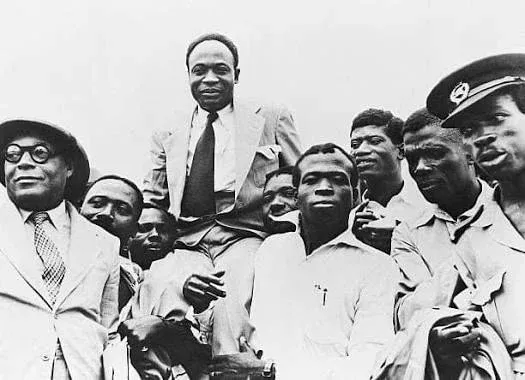
Consider the independence movement for Ghana: positive action. As a (mostly) nonviolent movement, positive action consisted of political education, propaganda, marches, strikes, boycotts, electoral organizing and riots (more on riots later).7 All these agitations were militant appeals for the British to concede control over the Gold Coast. By all but forcing their hand, the British Crown and Parliament granted independence via the Ghana Independence Act of 1957.8 This propelled the people of Ghana to have control over much of the State apparatus, including defense.
Upon earning independence, Ghana set out to help build revolutionary Pan-Africanism across the continent. Consequently, they faced violent forces, from both inside and out, who sought to undermine revolution on the continent before it started.9 Ghana's first prime minister, Kwame Nkrumah reflected this view during the tenth anniversary speech of the Convention People’s Party,
Imperialism and colonialism die hard. And what they fail to achieve in one form they try in another. We must therefore be on our constant and vigilant guard against any form of subtle domination by whosoever and from wheresoever.10
Ghana took great measures to defend its sovereignty and Africa as a whole. This included legislating repressive laws to quell insurrectionist attempts and training African troops to defend the continent.11 Yet and still, in 1966, Nkrumah's government was overthrown by a British and CIA-backed coup for its refusal to capitulate to imperialism.12 13 Imperialism had proven to be too relentlessly violent to overcome. The same State power that granted independence had now helped revoke it.
State violence: protector or predator?
Dr. Martin Luther King Jr., who was present in 1957 for Ghana's independence ceremony,14 learned similarly that the State can be both a protector and predator. Two days after escaping the KKK bus burning in Anniston, Alabama, the Freedom Riders and Dr. King found themselves inside a besieged Alabama church among a crowd of 1500.15 A white mob assembled outside, throwing firebombs at the church and flipping over cars. Ducked down in the church basement was Dr. King, lobbying for protection on a call with Robert F Kennedy, US Attorney General and brother to the 35th president.
After several pleas, the Alabama National Guard arrived to protect the besieged church. In his speech that night, King admitted the movement was in “for a season of suffering.” He later declared, “We will present our physical bodies as instruments to defeat the unjust system.”16 Yet, it was the suffering and sacrifice that brought the State—with all its instruments of violence—to their side.
Years later, King burned his bridge with the State by defying the silence reserved for leaders of his stature. By 1967, King staunchly opposed the US-led Vietnam War. He could no longer deny that his movement was in collaboration with the same predatory State that overthrew his comrade in Ghana. In the face of the atrocities committed abroad by his predatory country, he confessed it was hypocritical to lecture Black youth about rioting in the US,
Their questions hit home, and I knew that I could never again raise my voice against the violence of the oppressed in the ghettos without first having spoken clearly to the greatest purveyor of violence in the world today: my own government.17
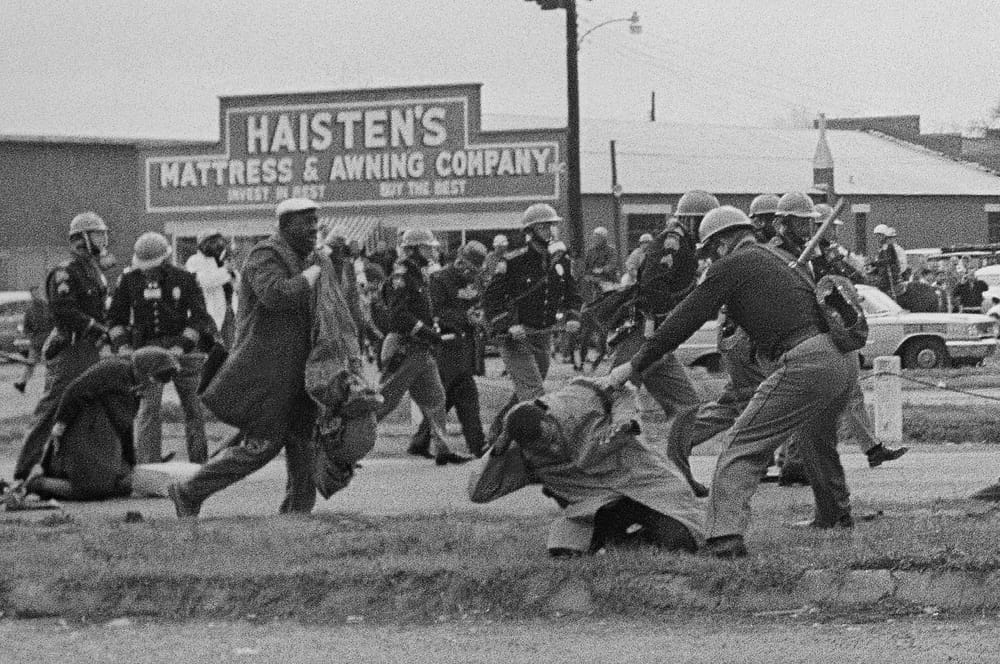
Following his Vietnam speech, civil rights leaders ostracized King for his moral consistency.18 The so-called nonviolent leaders had no problem with State violence as long as it protected their civil rights.19 In exchange for patriotic loyalty, nonviolence became a gentlemen's agreement to redistribute State violence in favor of a tepid racial equality.
Marxist historian Domenico Losurdo named how the redistribution of violence is no less violent in his book Non-Violence: A History Beyond the Myth.
The integration of schools in the South imposed by law, and secured by the intervention of federal troops, was no less violent than the segregation that had been imposed by the legal norms promulgated by the southern states for decades.20
When King began opposing the same State violence that bolstered his movement, he violated the aforementioned agreement. This “unpatriotic” violation likely played a role in his assassination.
It's a bloodcurdling reminder that the same State that has the power to protect you, also has the power to kill you too.
Insurgent positioning
In the first essay, nonviolence is reframed as sacrificial violence—a causal chain where one confronts power, provokes its worst impulses, consumes its brutality, and then amplifies the brutality to the world in hopes of achieving political concessions.21 However, such a confrontation with power roundly reverberates beyond the nonviolent goals of the sacrificial approach. In other words, not all who witness the brutality of the opponent will be inspired to consume it without reciprocity. Instead, they may return it with fervor.
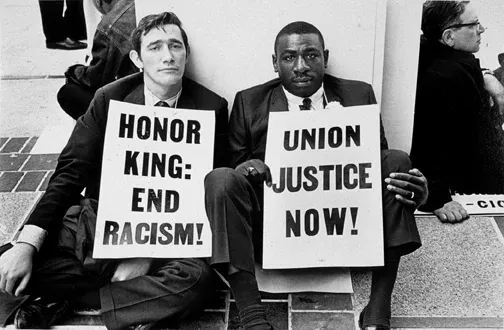
This was the case on April 4th, 1968, when Dr. King was assassinated. Nonviolence was not the weapon of choice; Black rage chose the flames. Over 100 US cities burned down in protest.22 As Kwame Ture observed, “This country made a mistake when they killed Dr. King…He preached love… they just opened the eyes of Black people who were afraid to pick up guns. Now they will.”23 Following the assassination, organizations like the Black Panther Party saw a dramatic surge in new membership.24
When the masses pick up a gun, coincidentally or not, it tends to strengthen the demands of nonviolent movements. This explains why, after King was assassinated, the US Congress suddenly found the votes to pass the Fair Housing Act, an anti-discrimination housing bill King had been pushing for years.25 Housing discrimination was wrong long before the State murdered King, but it only received life when more Black people picked up guns and rioted in the streets.
Years leading up to King's assassination, an insurgent Black radicalism had already helped fortify nonviolent integrationist positions. This is what sociologist Herbert H. Haines called “positive radical flank,” where the militant actions of one group strengthen the moderate actions of another. For instance, to hedge against the radicalization of Black Power, white philanthropic foundations increased funding for more moderate organizations.26 In direct response to Black riots, affirmative action and Black capitalism received increased government backing.27
Black Rage can be a powerful bargaining chip. Realizing this tendency of white capital to hedge their bets, Malcolm X purposefully pushed a militant line when speaking down in the US south: "If the white people realize what the alternative is, perhaps they will be more willing to hear Dr. King.”28 Unfortunately, far too many leaders saw this tendency as a means to launder Black rage through their bank accounts,29 instead of exploiting it for material improvements. Nevertheless, the fact remains that sometimes sacrificing the opponent benefits the position of those only willing to sacrifice themselves.
This paradoxical arrangement was not limited to the US. In 1948, British police in the Gold Coast (now Ghana) responded to the positive action movement by firing into a crowd of protesters. Predictably, riots broke out against British police after they mercilessly shot protesters in the streets.30
Nkrumah, the leader of the vanguard nationalist party at the time, cleverly capitalized on the riots to demonstrate that the British could not maintain the peace.31 His political party sent out telegrams to the United Nations and the international press, highlighting British brutality and proclaiming that power should be handed to their party. By exploiting the contradiction, they influenced the world to their side, and also persuaded more sympathetic parties inside Britain. Nonetheless, it took the masses taking it further than the nonviolent programming to maximize their position.
It's no coincidence that Ghana was inspired by the Indian Independence Movement, since the gunk tends to echo throughout the colonial experience. On February 4th, 1922, near the end of the non-cooperation movement— a disobedience campaign calling for a mass Indian boycott against British society—the tragic Chauri Chaura incident took place. Similar to Ghana, British police shot into a protesting crowd, killing several Indian peasants.32
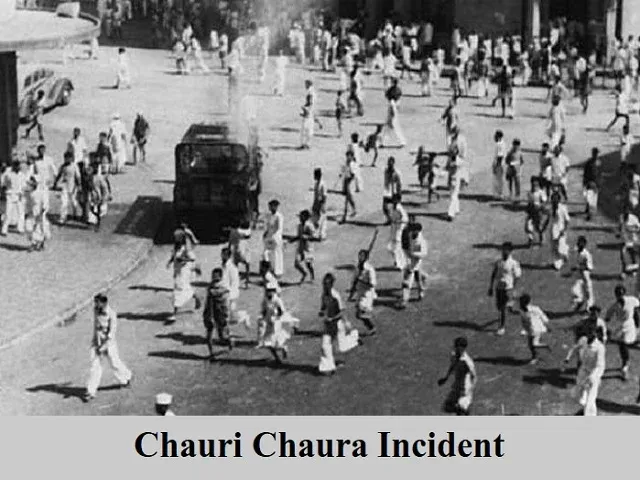
In a furious response, the raging crowd chased down the terrified police, who retreated inside their police precinct. Then, the raging crowd proceeded to burn it down with cops inside it, killing 22 British police in total. Feeling that this retaliatory violence contradicted the spirit of the movement, Indian National Congress leader Mahatma Gandhi called off the campaign.
Still, the deadly incident strengthened the movement by reminding the British that another threat existed. It also diversified it by motivating a younger generation of Indian nationalists who believed direct violence was necessary to defeat the colonial power.33 This element was continuous throughout the independence movement, as even Gandhi himself stayed in contact with militant groups despite their differences.34 These militant groups proved decisive as a Naval Mutiny against the British in 1946 was crucial in forcing Indian independence. As author and professor Justin Podur said of Indian independence,
“In the end, Indian people did not behave like otherworldly sages. They did what all colonized people do: they fought an armed struggle for independence.”35
Violence as a companion to nonviolence
History confirms that when the chips are down, confrontation with oppression is a sure fire bet. When the boot rests so heavily on the neck the people have no choice but to roll the dice. The binaries we erect have no influence on the odds. Violence and nonviolence are opposite sides of the same confrontational cube, so any attempts at separating them is a crapshoot in the gunk.
Thus, no social movement exists without its contradictions.
So we can forgive movements for battling to have State violence on their side. Who would not rather have the weapons aimed at their opponent than at them? Still, calling such behavior nonviolent is not only false but falls into what Losurdo identifies as an “ethic of conviction,” thereby forcing a doctrinaire view, instead of an “ethic of responsibility” to tell the truth.36
Truth is, violence from both the State and the insurgent masses aided movements in shaping the world we occupy today. This mixed formula is so effective that nowadays the US and its allies co-opt it to undermine the liberation movements and competing nation-states they despise. The US funds “democratic” movements that appear nonviolent, while secretly arming those movements to violently overthrow “authoritarian” nations like China, Venezuela, Cuba, Iran, and others.37 38
They know the presumed innocence of these movements nostalgically resonates with the State-curated images of a harmless King and a jolly Gandhi. Still, as already demonstrated, the truth is almost always messier. Particularly when the faint line between nonviolence and violence is no less than an astigmatism.
Thus, to the sympathetic onlooker, nonviolence neither provokes violence nor inspires others to engage in it on their behalf. Its practitioners are simply laying down their lives for a noble cause, spotless of any drooling blood. It need not matter if the thrower of a Molotov cocktail or the boot of the State stands behind them in support.
In this sense, nonviolence is more propaganda than reality. By appearing defenseless, it creates a veneer of “innocence” which yields the propaganda value of the moral high ground. By maintaining the moral high ground, all that violent stuff happens elsewhere, like recycling. This permits nonviolent practitioners to court violence while maintaining the appearance of innocence. It allows it to swim in the gunk without any of it publicly sticking.
We may all yearn for the absence of violence, but any momentary absence is a vacuum craving for more violence to fill it. History proves that violence can be wielded in an assortment of ways; however, it must be wielded. Despite the best intentions of its practitioners, nonviolence is no less a tactic to become the wielder of violence, and/or to influence the wielding.
The inevitability of violence is not an automatic descent into corruption. Nor does it make violence an acceptable response to all human interaction. Dialectically, it's a clear acknowledgement that violence cannot be displaced into the ether. There's always a landfill of sacrificial bodies being dumped somewhere to preserve the idea of nonviolence. To flippantly dismiss violence outright is a failure to accept the relationship of the boot to the neck.
As we say in Black Alliance For Peace, “peace is not the absence of conflict” but a struggle to be won. What all successful movements have understood is that confrontation is a must. The same is true today, as a violent climate is still being imposed on us. But one cannot recycle without confronting the imposers of waste. One cannot achieve peace without seizing the power to impose it. Frankly, there's no other way for our necks to breathe.
NOTES
1 Mohandas Gandhi, Gandhi on Non-Violence: Selected Texts from Mohandas K. Gandhi’s Non-Violence in Peace and War, ed. Thomas Merton (New York, NY: New Directions Pub, 2007), 37.
2 Stokely Carmichael, Stokely Speaks: From Black Power to Pan-Africanism (Chicago, IL: Lawrence Hill Books, 2018), 168.
3 Stanton Young, “Capitalism’s Recycling Lie,” In Defence of Marxism, April 26, 2022, https://marxist.com/capitalism-s-recycling-lie.htm.
4 Sullivan, Laura. “How Big Oil Misled the Public into Believing Plastic Would Be Recycled.” NPR, September 11, 2020. https://www.npr.org/2020/09/11/897692090/how-big-oil-misled-the-public-into-believing-plastic-would-be-recycled.
5 Frantz Fanon, The Wretched of the Earth (New York: Grove Press, 2021), 41.
6 Rasul Mowatt, The Geographies of Threat and the Production of Violence: The State and the City Between Us. (New York and London: Routledge Taylor & Francis, 2021.), 2.
7 Presbey, Gail. “Nonviolent Resistance in the Independence Movement, 1890s–1950s.” Essay. In Recovering Nonviolent History Civil Resistance in Liberation, 51–64. Boulder, CO: Lynne Rienner Publishers, Inc., 2013.
8 Smith, S. A. “The Independence of Ghana.” The Modern Law Review 20, no. 4 (July 1957): 347–63. https://doi.org/10.1111/j.1468-2230.1957.tb00448.x
9 A. Susan Williams, White Malice: The CIA and the Covert Recolonization of Africa (New York: PublicAffairs, Hachette Book Group, 2023), 529.
10 Kwame Nkrumah and Samuel Gyasi Obeng, Selected Speeches of Kwame Nkrumah. Volume 1 (Ghana: Afram Publications, 1979), 2.
11 Wiiliams, White Malice, 564.
12 Elmaazi, Mohamed. “Top Secret Document Exposes UK Role in Ghana Coup.” Declassified UK, May 18, 2025. https://www.declassifieduk.org/top-secret-document-exposes-uk-role-in-ghana-coup/#:~:text=The%20UK%20Foreign%20Office%20conducted,ending%20the%20war%20in%20Vietnam.
13 Williams, White Malice, 580-587.
14 “Ghana Trip,” The Martin Luther King, Jr. Research and Education Institute, accessed February 12, 2026, https://kinginstitute.stanford.edu/ghana-trip.
15 Thomas E. Ricks, Waging a Good War: How the Civil Rights Movement Won Its Battles, 1954-1968 (Waterville, ME: Thorndike Press, a part of Gale, a Cengage Company, 2023), 108.
16 Ibid, 109.
17 Beyond Vietnam Speech.
18 The Autobiography Of Martin Luther King, Jr.
19 Missiles have no colour: African Americans’ reactions to the Cuban Missile Crisis: Cold War History: Vol 15, no 1, accessed February 13, 2026, https://www.tandfonline.com/doi/abs/10.1080/14682745.2014.904291?tab=permissions&scroll=top.
20 Domenico Losurdo and Gregory Elliot, Non-Violence: A History beyond the Myth (Lanham: Lexington Books, 2017), 115.
21 Too Black, “How Nonviolent Protests or Civil Resistance Is Violence, Too,” Grassroots Thinking, January 25, 2026, https://www.grassrootsthinking.com/nonviolence-is-violence-too-somebodys-gotta-die/.
22 “Assassination of the Reverend Dr. Martin Luther King, Jr..,” Department of Justice, April 21, 2023, https://www.justice.gov/crs/timeline-event/assassination-reverend-dr-martin-luther-king-jr.
23 Ture, Kwame. “Stokely Carmichael Kwame Ture on the Killing of Dr. King 1968.” YouTube. Accessed February 13, 2026. https://youtu.be/UeadqiqpknE?si=etRk0ouZkBNr_Iiz.
24 Joshua Bloom and Waldo E. Martin, Black against Empire: The History and Politics of the Black Panther Party (Oakland, CA: University of California Press : University of California Press, 2016), 203.
25 “History of Fair Housing,” US Department of Housing and Development, accessed February 13, 2026, https://web.archive.org/web/20120327032116/http://portal.hud.gov/hudportal/HUD?src=%2Fprogram_offices%2Ffair_housing_equal_opp%2Faboutfheo%2Fhistory.
26 Black Radicalization and the Funding of Civil Rights: 1957-1970 Author(s): Herbert H. Haines.
27 John David Skrentny, The Minority Rights Revolution (Cambridge, MA: Harvard University Press, 2022), 166.
28 Coretta Scott King, My Life with Martin Luther King, JR (Toronto: CNIB, 2012).
29 Too Black and Rasul A. Mowatt, Laundering Black Rage: The Washing of Black Death, People, Property, and Profits (New York, NY: Routledge, 2024).
30 Presbey, Gail. “Nonviolent Resistance in the Independence Movement, 1890s–1950s”.
31 Ibid.
32 Shahid Amin, Event, Metaphor, Memory: Chauri Chaura 1922-1992 (Berkeley, CA: University of California Press, 2008).
33 Sahilbeg, “Explained: Chauri Chaura, Freedom Struggle Signpost from 100 Years Ago,” The Indian Express, February 3, 2021, https://indianexpress.com/article/explained/chauri-chaura-incident-freedom-struggle-7173592/#google_vignette.
34 Justin Podur, “The Myth of India’s Freedom,” The Myth of India’s Freedom - by Justin Podur, April 11, 2024, https://savageminds.substack.com/p/the-myth-of-indias-freedom.
35 Ibid.
36 Losurdo, Domenico, and Gregory Elliot. Non-violence: A history beyond the myth. Lanham: Lexington Books, 2017. 207.
37 Domenico Losurdo, “‘Non-Violence,’ ‘Color Revolutions,’ and the Great Game,” essay, in Non-Violence A History Beyond the Myth (Lanham, MD: LEXINGTON BOOKS, 2015), 191–203.
38 Brian Berletic, “Washington’s War on Iran: The Importance of Defending Information Space,” New Eastern Outlook, January 15, 2026, https://journal-neo.su/2026/01/15/washingtons-war-on-iran-the-importance-of-defending-information-space/.