

Part I of this series, “‘Cuba: Capital of 21st Century Communism’: The Current Red Scare and its Implications for Black Radicalism,” examined selections from the recent Cuba report with a particular focus on its implication for radical Black folks. Part II continues the exposition of excerpts that illuminate the rhetorical strategies employed by the U.S. government to criminalize militant fightback. While this quintessential Red Scare document has largely fallen out of the political discourse, deconstructing it helps us identify the claims, arguments, and objectives of current state propaganda. Such understanding requires critical media literacy, which is the ongoing examination, interrogation, and questioning of the reigning ideologies, ownership, production, and distribution of media. As the organic intellectual and critical media scholar D. Musa Springer explains, media “extends to all arms of the state and their proxies that operate as information disseminating wings of a larger state apparatus.” It is a powerful tool to shape “societal norms, political perspectives, and cultural ideologies.” The purpose of critical media literacy is to illuminate and unpack the embedded power relations and prerogatives that determine what audiences are exposed to, and to analyze the relationship between knowledge and power. The state and private corporations constantly bombard us with content aimed at shaping what we know, how we think, and what ideas we consider legitimate. This is done through suppression, omission, distortion, and lying, all of which can be found in the Cuba document. Of particular importance is “face-value framing,” which Springer describes in the following way:
One way to lie is to accept at face value what are known to be lies, passing them on to the public without adequate countervailing response. Face-value framing has characterized the press’s performance from the McCarthy era down to more recent times... Without ever saying a particular story is true or not, but treating it at face value, the press engages in the propagation of misinformation-while maintaining the myth that they are merely noncommittal and objective.
Critical media literacy is foundational to the battle of ideas between the forces of liberation and human flourishing, and the forces of imperialism and death dealing.
- “Cuba’s role in forming this militant Third Worldist consciousness among black radicals was not just ideological but institutional… Figures like Carmichael typified Cuba’s influence in driving a faction of the black civil rights movement to embrace political violence, shifting from a desire to integrate into American society to a determination to wage revolution against it.” (p. 57)
With this argument, the Cuba document assails radical Black agency, ideas, and institutions. The claim that Black internationalist consciousness was “formed” by Cuba distorts the reality that such consciousness was the basis for building solidarity with not only Cuba, but also Vietnam, Angola and Mozambique, Palestine, Libya, and elsewhere. In other words, radical Black people developed a Third Worldist consciousness through relationships, organizing, and study, not through Cuban imposition. Relatedly, for decades, if not centuries, Black revolutionaries in the belly of the beast understood the interconnectedness of slavery, colonialism, imperialism, patriarchy, Jim Crow, apartheid, corvée, latifundia, etc., and this understanding made post-revolutionary Cuba a natural ally. Only the racist white imagination would construe this knowledge as a Cuban plot to undermine U.S. society. Additionally, in highlighting “institutional” support from Cuba, the report aims to bring scrutiny to the resources, networks, and capabilities of radical Black individuals and organizations. Taken together, this caricature of the relationship between Cuba and Black radicals attempts to obfuscate that endogenous oppression and exploitation create the conditions for militant internationalism and the rejection of assimilation; that this radicalism is not a product of foreign influence, but rather of homegrown outrage; that U.S. imperialism incites internally colonized peoples’ revolutionary impulse; and that Black militants are comrades to, not puppets of, Cuban revolutionaries.
- “IFCO provides another example of how the Cuba-ICAP solidarity network facilitates radical agitation within the United States. The foundation serves as “fiscal sponsor” for a suite of far-left domestic activist groups, facilitating tax-exempt donations—and handling grant management, tax compliance, financial reporting, and other administrative activities—to a network of radical organizations and collectives.” (p. 72)
Financial terrorism is essential to Red Scare political repression. It has a particularly deleterious effect on radical Black organizations, which tend to be resource deprived. This economic punishment bankrupts organizations by, for example, criminalizing the flow of resources to them, from donations to dues; embroiling them in costly litigation; and seizing property and assets. “Cuba: The Capital of 21st Century Communism” uses financial terrorism as a rhetorical tool by construing IFCO’s fiscal sponsorship of certain organizations as supporting extremism. More than establishing guilt by association, the report presents fiscal sponsorship as material supporting subversive organizations. On this logic, grant writing and bookkeeping are acts of domestic terrorism.
- “In recent years, the People’s Forum has emerged as one of the most significant left-wing protest groups in the United States, serving as a centralized hub for anti-Trump, anti-ICE, and pro-Cuban agitation.” (p. 79)
The People’s Forum is a multiracial, multinational physical, educational, and cultural space for progressives and radicals to convene. Because it serves as a source of connection, the Cuba report paints it as a clearing house of subversion and domestic terrorism. The People’s Forum is mischaracterized as a group, which allows the government to misrepresent anyone who enters, buys from, convenes or holds an event at, takes a course from, or donates to it as supporters of left extremism or domestic terrorism. It terms of rhetoric, placing “anti-Trump” and “anti-ICE” alongside “pro-Cuba,” creates a chain of signification whereby being against the kleptocrat-in-chief and the modern-day Schutzstaffel (SS) automatically makes one “pro-Cuba,” which in this context means “anti-American.” Thus, to support the People’s Forum is to be against America. This discursive move is the basis for establishing guilt by association, which dissuades people from supporting individuals, establishments, organizations, and movements out of fear that they may be targeted by the state. The Cuba document further establishes guilt by association by linking the People’s Forum to Roy Singham, a “Shanghai-based,” “former Marxist militant organizer” who “maintains close links with the Chinese Communist Party,” and who has “emerged in recent years as one of the most influential living sponsors of far-left groups and causes.” Even worse, he had been a member of the League of Revolutionary Black Workers. (p. 79) The government’s characterization of Singham demonstrates the antiradicalism and anti-Blackness of the document.
- “Many of the most significant upheavals in recent American political history—from the George Floyd riots to the rise of Antifa to the explosion of pro-terrorist activism on American college campuses—can be linked, in some way, shape, or form, to Cuban influence.” (p. 98)
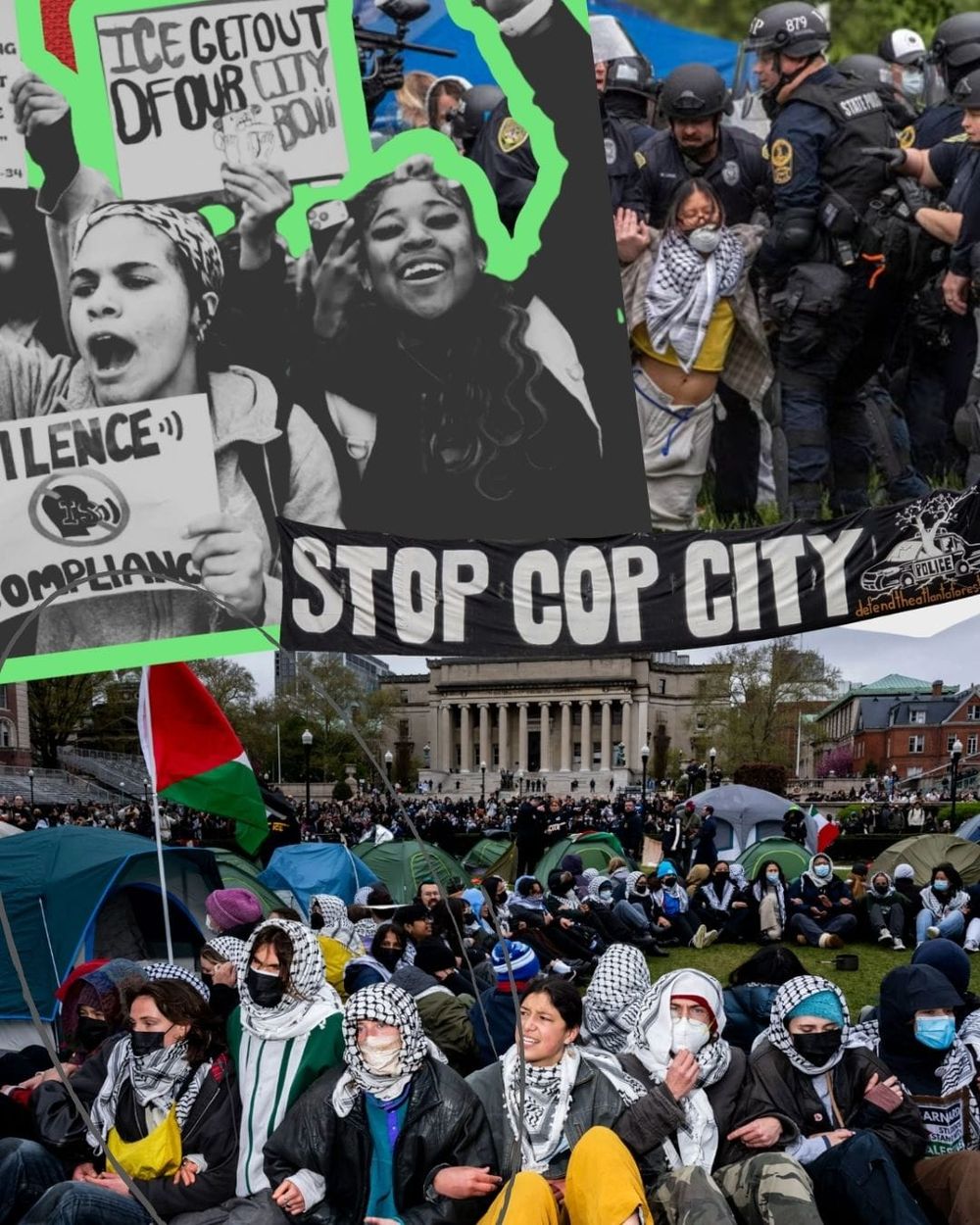
This argument is pernicious for several reasons. First, it rhetorically establishes a direct relationship between the uprisings in response to the murder of George Floyd, the loose network of antifascists known as “Antifa,” the student intifada, suggesting that these have a common nefarious source. Second, the document displaces U.S. violence that creates the conditions for “upheavals” onto Cuba. In other words, the report effectively argues that interracial insurgency against police brutality, networked opposition to fascism, and student militancy to stop the genocide in Gaza are not responses to U.S. domestic and foreign policy, but rather subversive acts influenced by Uncle Sam’s archnemesis. Such mystification legitimates the dual strategy of asphyxiating the Cuban revolution and suffocating internal dissent. Likewise, the Cuba report misconstrues legitimate fightback as “upheavals,” “riots,” and “pro-terrorist activism” by connecting it to an external enemy. It also transforms freedom of speech, assembly, expression, and association into criminal acts.
- “Whereas the early Cuba solidarity networks were often confined to the militant fringe, DSA represents a newer and far more politically consequential development: a mass-membership organization operating openly in American electoral politics, with chapters across the country, a growing bench of elected officials, and real influence inside the Democratic Party coalition. The DSA has built a national infrastructure dedicated to moving extreme-left politics from the margins into the mainstream–and with it, a deep and abiding devotion to the Cuban regime.” (p. 85)
The focus on the Democratic Socialists of America (DSA) in “Cuba: Capital of 21st Century Communism” undergirds the claim that leftwing “extremism” is seeping into mainstream politics, thereby infecting the American polity. If DSA—or other left or progressive mass-membership national organizations—are participating in electoral politics and getting people elected, then elections become suspect and attacks on the Voting Rights Act are legitimized. If they are building chapters across the nation, then they can be effectively targeted with RICO charges. If they are influencing the Democratic Party, then the Republican Party becomes the “True American” party and the Democrats are the un-Americans, even as they do everything they can to dismiss and distance themselves from the “radicals.” On this logic, even though DSA is not under foreign influence, it is even more pernicious because it has a valence of legitimacy that allows it to impact U.S. politics and society. The infamous FBI leader J. Edgar Hoover described the danger of communism in a similar way. He asserted:
What is important is the claim of the Communists themselves that for every Party member there are ten others ready, willing, and able to do the Party’s work. Herein lies the greatest menace of Communism. For these are the people who infiltrate and corrupt various spheres of American life. So rather than the size of the Communist Party, the way to weigh its true importance is by testing its influence, its ability to infiltrate.
Deeming an organization “extremist” based on potential infiltration or influence expands the dragnet of criminalization and turns legitimate politics into subversion.
- “Cuba’s assault on the United States was never, at root, a quarrel over economic policy or sovereignty or even ownership of a particular territory. It was a revolution against Western civilization itself—waged, in part, via the novel and insidious method of persuading the children of the West to turn against their own inheritance. That is the campaign Castro launched in 1959, and it is the campaign his heirs are waging still. And in the institutions of the modern American left—in its universities and its nonprofits, its street movements and its media—that campaign has enjoyed a success its founders could scarcely have imagined.
Distortions, obfuscations, and outright lies abound in this concluding statement of the Cuba report. First and foremost, it is the United States that has systematically assaulted Cuba and every other Global South country committed to their own liberation and development, not unlike the U.S. government that terrorizes the very groups it classifies as domestic terrorists. Likewise, Cuba’s challenge to the United States, like that of internally colonized Black folks, is foundationally about economic policy, self-determination, and political freedom, just as the United States’ aggression toward Cuba and the internal colonies is about economic exploitation, social control, and political domination. The “revolution against Western civilization” is in fact a revolution for People(s)-centered human rights unencumbered by capitalism and imperialism. Relatedly, “the children of the West,” read white people, are turning against “their inheritance,” i.e., the plunder wrought from settler colonial racial capitalism, because the “wages of whiteness” have not been adjusted for inflation. In other words, non-elite whites are increasingly being treated with the viciousness typically reserved for Black and colonized peoples, and this is motivating some of them to embrace international, interracial, and/or class solidarity. Further, to the extent that “modern American left” movements and media have been inspired by the Cuban revolution, it is because of the alternative it provides to rapacious, death-dealing capitalism, not because radicals are dupes or puppets of the Cuban government. Additionally, the universities and non-profits are not incubators of left ideology as the report claims; they are institutions of class reproduction that are generally hostile to radicalism that cannot be co-opted or commodified. In the final analysis, it is eroding social and material conditions, in the context of unconscionable warmongering and fascist revival, that are persuading principled USians to expand their cartography of struggle to Cuba, Haiti, Palestine, Iran, and elsewhere. The narrative the report presents about Cuba and its relationship to radicalism generally, and Black radicalism particularly, is meant to throw dirt in the eyes of the people.
The propaganda espoused in “Cuba: Capital of 21st Century Communism” aims to deter the masses from support for Cuba, joining radical organizations, building counterhegemonic movements, and developing revolutionary consciousness. It seeks to turn the most competent organizers, activists, and institutions into pariahs so that the people have no choice but to accept their immiseration. As Claudia Jones explained in a similar Red Scare context, “Today, in our country there are those who do not only want to ‘find masters’ anew for our people; they want to rob our people of its honored and respected leadership—leadership of any persuasion who refuse to kowtow with heads tied and knees bowed to satisfy themselves with crumbs from reaction's tables.” Critical media literacy is a potent tool for rejecting “crumbs from reaction’s tables” by demystifying Red Scare propaganda like the Cuba report.
Dr. Charisse Burden-Stelly is a Black Studies scholar of political theory, political economy, intellectual history, and political and historical sociology. Her published work includes Black Scare/Red Scare: Theorizing Capitalist Racism in the United States andW.E.B. Du Bois: A Life in American History. She is also the co-editor of Organize, Fight, Win: Black Communist Women’s Political Writings and of Reproducing Domination: On the Caribbean and the Postcolonial State
Find Dr. CBS on Substack