
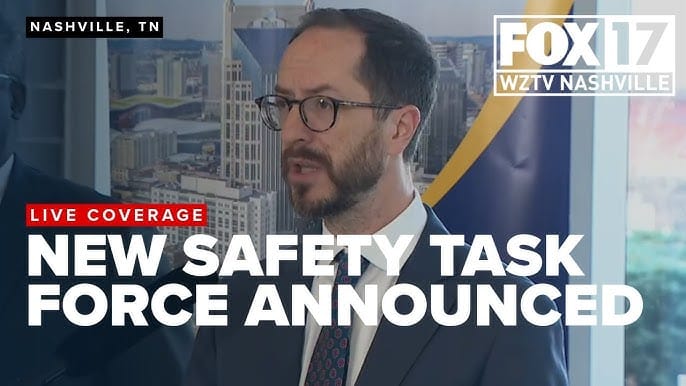
Mayor Freddie O’Connell has announced a so-called “Community Safety Task Force.” What has not been acknowledged is how this process was deliberately removed from community control before it was publicly announced.
As part of the Nashville People’s Budget Coalition’s “Housing and Safety for All Plan,” community organizations advanced a transparent model for developing a community safety plan rooted in prevention, youth investment, and long-term accountability. That model called for a community-driven process with clear authority, continuity, and public oversight.
Specifically, the proposal called for new positions within the Metro Human Relations Commission dedicated to leading a community safety planning process and monitoring its implementation over time. Rather than support this approach, Metro leadership redirected the process away from the Human Relations Commission and toward Metro Public Health. Weeks before the task force was to be seated, the Mayor’s Office vetoed many of the community leaders identified through that process and replaced them with its own selections. What is now being presented as a “community-based” task force is, in fact, a mayor-controlled advisory body.
This sequence matters. It shows that a transparent, community-led process was not merely sidelined, but actively displaced and reconstituted under executive control.
The sidelining of this process also reflects a broader and familiar pattern in Nashville governance: Black-led public safety initiatives are frequently displaced or diluted once they move from advocacy to implementation. The Office of Youth Safety—created through organizing by Black residents and approved by Metro Council as part of the Varsity Spending Plan—has been functionally marginalized in the formation of this task force, despite its mandate and expertise. This mirrors earlier moments in Nashville’s history in which community victories were followed by the creation of parallel, mayor-controlled bodies that neutralized independent oversight.
This is not an accident. It is a pattern.
In Nashville, community-led and community-accountable efforts are repeatedly welcomed in name, then overridden once they threaten executive authority or predetermined outcomes. We have seen this with the nullification of community oversight initiatives, the expansion of surveillance under the banner of public safety, and the reduction of investment in youth safety and prevention infrastructure even as enforcement budgets grow. This task force fits squarely within that governing logic.
The issue is not the integrity or commitment of individual appointees, many of whom are respected community members. The issue is structural. A process cannot be meaningfully “community-based” when participation is politically gated, leadership is vetoed, and authority remains centralized in the Mayor’s Office. Under these conditions, task forces function to absorb public concern and validate existing priorities rather than to transfer power or reshape outcomes.
Notably, concerns about the structure and purpose of the task force have been raised even by individuals appointed to serve on it, underscoring that the problem is not exclusion alone, but the design of the process itself.
Black Alliance for Peace – Nashville formally objects to the structure and legitimacy of this task force and will not endorse or legitimize a process that substitutes managed participation for shared power. We remain committed to public safety approaches rooted in prevention, public health, youth investment, and genuine community authority.
Community safety cannot be achieved through managed participation. It requires shared power, real accountability, and durable community control.